Standing All Day? How to Protect Your Legs, Feet, and Back
Occupational health research has studied prolonged standing for decades. Here's what it recommends — translated into a practical survival guide for anyone whose job happens on their feet.

(Image credit: Wellness Research Daily)
Office workers get endless advice about sitting too much. The millions of people who stand for a living get far less — even though occupational health research treats prolonged standing as a genuine physical stressor in its own right, consistently linked to lower-limb discomfort, fatigue, and back complaints. If your job happens on your feet, this one's for you.
Why standing still is so tiring
Walking and standing look similar and behave completely differently. Walking shares load across muscle groups and keeps the calf muscle pump — the contraction-driven system that returns blood from your lower legs — running continuously. Standing still does neither: the same muscles hold the same position for hours while circulation in the lower legs slows, fluid gradually pools, and pressure sits on the same points of your heels and forefeet without variation.
This is why a shift behind a till can feel more exhausting than a day of walking twice the steps, and why the complaints cluster exactly where they do: feet, calves, lower back.
The playbook, in order of impact
Bodies like the Canadian Centre for Occupational Health and Safety have published guidance on prolonged standing for years, and it converges with what experienced shift workers figure out themselves. The pillars:
- Never stand truly still. Position variety is the cheapest intervention there is. Shift weight side to side, change stance, prop one foot on a low rail or box and alternate — the bartender's trick that flattens the lower back's arch and unloads it. Micro-movement keeps the calf pump ticking and the pressure points rotating.
- Get serious about footwear. Resilient cushioning that recovers rather than flattens, a wide stable base, and room for feet that swell by afternoon. Two pairs in rotation outperform one premium pair, because midsole foam recovers between wears.
- Wear light graduated compression. Compression socks assist exactly the circulation your still calves aren't driving — pressure strongest at the ankle, easing upward, supporting venous return. Light levels around 12–15 mmHg are the ones that survive a full shift comfortably, which is the entire game: support you remove at hour six helps nobody.
- Stand on the right surface when you can. Anti-fatigue matting is standard occupational-health advice for stationary standing — the slight instability prompts continuous tiny muscle adjustments that substitute for the movement you're not getting. For mobile standing work, this budget goes to shoes instead.
- Use breaks to change state, not just location. A five-minute walk moves pooled fluid better than five minutes slumped in the break room — though sitting with feet propped has its place at the end of a stretch. The ideal break rotates the body through something different from the last two hours.
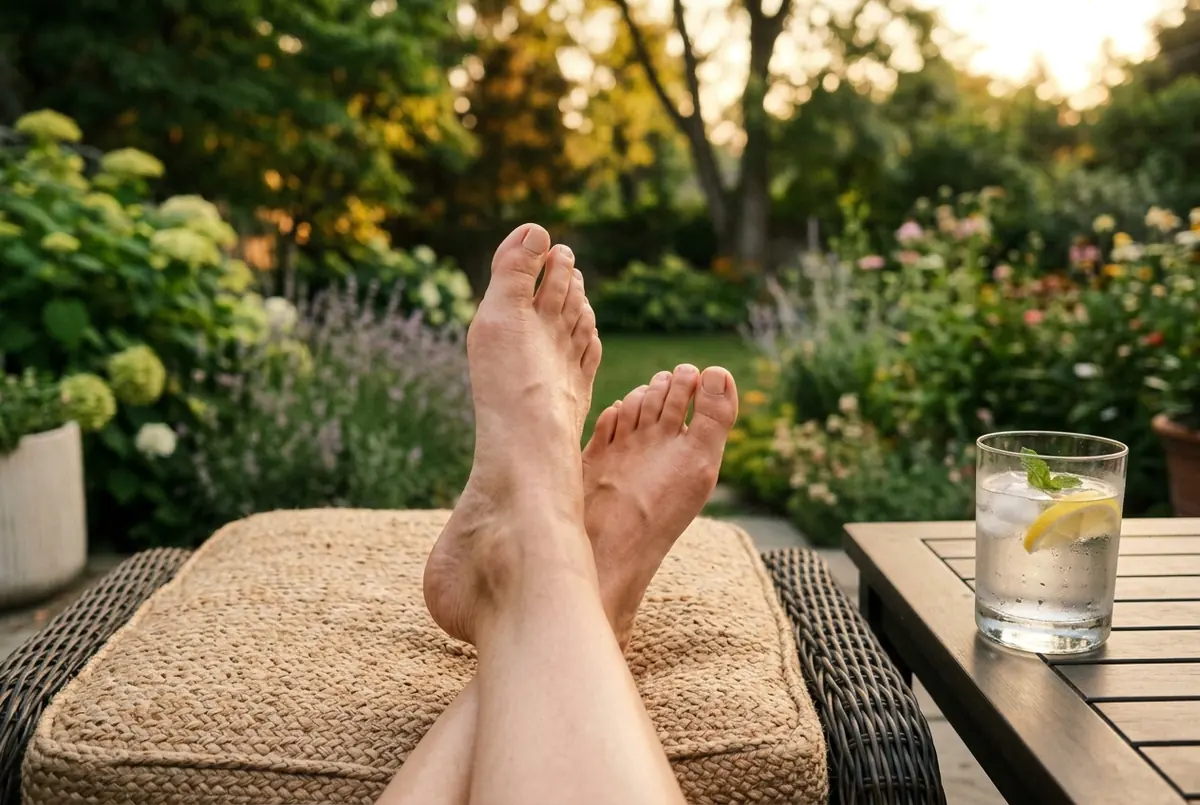
- Finish with elevation. Feet above heart level for ten to fifteen minutes after a shift is the cheapest recovery protocol in existence, and it works for the same gravitational reasons the shift was hard.
The back deserves its own paragraph
Standing back-ache usually traces to locked knees and a rigid, arched posture held too long. Soft knees, the foot-on-rail rotation, occasional gentle backbends and forward folds during quiet moments, and core-friendly habits outside work all reduce the load. If your employer offers sit-stand rotation, take it — the research on standing work points the same direction as the research on sitting work: the problem is any single position sustained, and the medicine is variety.
The honest summary
None of this is dramatic, and that's rather the point. Stack small mitigations — footwear, compression, surfaces, micro-movement, elevation — across a fifty-hour standing week, and the difference by Friday night is anything but small. Your legs weren't designed for stillness. Give them motion in whatever doses the job allows, and support them where it doesn't.